
For founders building defence, security, and resilience (DSR) technologies, two organisations sit at the centre of NATO’s innovation ecosystem: NATO DIANA and the NATO Innovation Fund (NIF). They are closely linked and mutually reinforcing, but serve distinct functions and engage with startups at different points in their journey.
In the fourth session of the NIF’s “DSR Playbook” webinar series, John Ridge, Chief Adoption Officer at the NIF, and Ryan Benitez, Chief Commercial Officer at NATO DIANA, set out the practical realities of working with both organisations.
Two organisations, two mandates: sequential and complementary
DIANA and the NIF share a mission – accelerating the adoption of emerging technologies across the Alliance – but differ fundamentally in structure and function
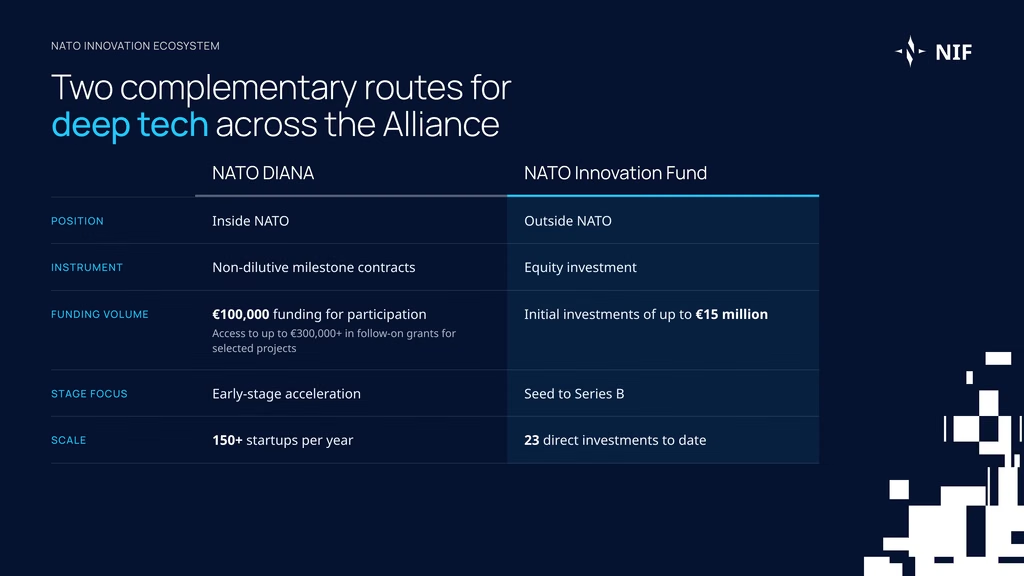
DIANA was created by NATO in 2021 and became operational in 2023. Its mandate is to find the best commercial solutions across the alliance and accelerate their delivery to warfighters. The NIF was deliberately set up as a standalone venture capital fund by 24 allies, mandated to invest €1 billion into deep tech supporting defence, security, and resilience, taking equity in return.
How DIANA works
DIANA’s model starts with challenge formation. Problem statements are sourced from the 32 allies, warfighters, and NATO headquarters, then translated into commercially legible briefs. Companies are told what problem needs solving, not what solution to build.
Selection is competitive and merit-based across three stages: technical evaluation, military end-user review, and commercial scalability assessment. There are no national quotas. DIANA receives thousands of applications and supports a small fraction.
Selected companies receive:
- A first NATO contract worth €100,000 (milestone-based, not a grant)
- Additional non-dilutive funding for testing, evaluation, and operational exercises
- Placement in NATO exercises alongside end users, with the option to move to a prototyping contract via DIANA’s rapid adoption service
DIANA is moving from annual challenges to dynamic challenges that can be launched at any point in the year when an ally brings an urgent, funded, and well-defined problem. New challenges will include adoption pathways defined from the outset.
How the NIF works
Unlike DIANA, the NIF does not issue challenges. It operates as a hunter-gatherer: sourcing opportunities through fund-of-funds investments in earlier-stage funds, referrals from ministries of defence and industry partners, direct pitches via the NIF website, and engagement at conferences and tech events.
The NIF’s primary filter is whether a company could contribute to NATO defence, security, or resilience. Beyond that, it looks for venture-backable businesses with the potential to grow substantially. It does not fund basic research and generally invests from around TRL 3–4, though its portfolio spans the full range – from early-stage companies to mature businesses such as Tekever, operationally deployed in Ukraine. The NIF also invests in earlier-stage funds as a capacity-building tool, seeding underserved parts of the ecosystem and creating a pipeline for future direct investments.
When pitching to the NIF, founders should be prepared to address:
- The specific problem being solved and why it matters for DSR
- What makes the technology defensible – the IP moat
- How the investment will be deployed and what it will achieve
- The credible path to scale across NATO markets
DIANA participation is not a prerequisite for NIF investment, but it provides competitive validation that strengthens a pitch considerably.
What each organisation does for startups
DIANA and the NIF each deliver distinct but complementary value once a startup is engaged.
DIANA’s selection process meets competitive NATO procurement standards, meaning alumni can be fast-tracked onto subsequent contracting processes – a structural advantage private-sector accelerators cannot replicate. Two NIF portfolio companies, Aquark and Kelluu, are also DIANA alumni. Founders are encouraged to treat DIANA participation as a structured feasibility phase: test the technology in a defence environment, gather end-user feedback, address certification and interoperability requirements, and assess scalability across 32 NATO markets.
The NIF’s value extends well beyond the cheque. Through its Mission Platform Group, the NIF provides post-investment adoption support – actively working with ministries of defence to open procurement pathways for portfolio companies, and helping navigate the uneven competitive landscape that startups without a track record of defence contracts typically face. In addition, NIF’s PROTECT programme provides rigorous screening, practical guidance, and ongoing counsel to ensure that innovations are protected by more than just firewalls and NDAs. NIF has further created a Responsible Use Framework aligned with NATO’s Principles of Responsible Use (PRUs) and supports portfolio companies post-investment to implement responsible use into their AI systems and governance.
Testing, evaluation, and operational exercises
Testing is one of DIANA’s most practically valuable offerings. Companies can apply for additional funding to access one of DIANA’s 180-plus test centres, covering requirements from electromagnetic environment testing to temperature performance and clinical validation. DIANA helps identify the right facility once end-user feedback has defined what needs to be tested.
Beyond the laboratory, DIANA embeds innovators in NATO operational exercises, enabling real-conditions testing, direct iteration with end users, and integration assessment with existing systems. The NIF coordinates its own portfolio companies on these exercises alongside DIANA, working with Allied Transformation Command, SHAPE, I Command, LANDCOM, and SOFCOM. This exposure – to demanding environments and to end users who may not have known the capability existed – is difficult to replicate through any other route.
Key takeaways
- Understand where each organisation fits. DIANA de-risks and validates; the NIF scales with capital and adoption support. They are sequential and complementary.
- Use DIANA as a feasibility phase. End-user feedback, interoperability testing, and market assessment across 32 NATO markets make subsequent fundraising significantly easier.
- Build your pipeline systematically. Selection for both organisations is genuinely competitive. Non-selection reflects timing, stage, or portfolio fit – not company quality. Maintain multiple parallel lines of opportunity.
- Be specific about the defence use case. Dual-use companies must articulate clearly how their solution benefits a defence stakeholder. Operational relevance should be obvious from the first conversation.
- Think deliberately about your cap table. The right investors bring access, network, adoption support, and IP protection – not just capital.
Defence procurement culture is shifting towards faster cycles and greater openness to new entrants. Capital is moving into the space, nations are building new on-ramps for emerging technology companies, and the Alliance’s appetite for rapid adoption has never been stronger. For founders who engage strategically with both organisations, the path from technological breakthrough to operational impact is more navigable than it has ever been.
Media contact: press@nif.fund →