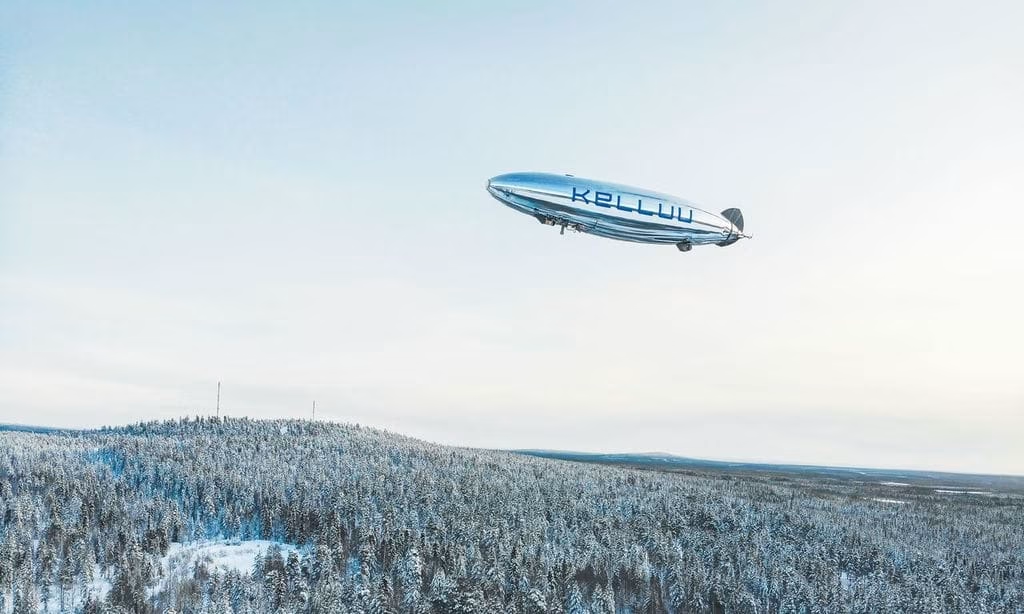
NATO Innovation Fund leads the round, marking its first investment into a Finnish company
- Funding will be deployed on international growth as Kelluu enters new markets this year
Kelluu will invest in further development of its technology, AI capabilities, fleet expansion, and growing its team
Today, the NATO Innovation Fund announced its investment in Kelluu – a deep tech company operating the world’s largest autonomous airship fleet. This marks the Fund’s first direct investment in Finland, and follows Kelluu’s successful completion of two phases of NATO’s DIANA (Defence Innovation Accelerator for the North Atlantic) program. Keen Venture Partners, VC Gungnir Capital, and Finnish state-owned investment company Tesi also invested in the round.
With its unmanned airships, Kelluu delivers 24/7 monitoring across vast areas and intelligence gathering with drone-level detail. Uninhibited by extreme weather, GPS jamming, high operational costs and regulatory constraints, the Kelluu fleet delivers continuous coverage, data collection, and connectivity across wide and remote areas, enabling earlier threat detection and safer, more efficient operations.
As Europe ramps up defence investing with a focus on closing urgent capability gaps, persistent ISR (Intelligence, Surveillance and Reconnaissance) has emerged as a critical area for strengthening NATO’s deterrence posture across the Eastern Flank, maritime approaches, and the High North. By combining persistence with high-precision sensing, Kelluu’s autonomous airships fill a critical gap between satellites and drones.
Existing technologies were designed for a different era: satellites provide broad coverage but lack the resolution required for many operational tasks. Drones deliver high-quality data but cannot remain airborne for extended periods and in certain environments, such as icing and strong winds in Arctic or complex airspace over densely populated areas. Ground-based radars are fixed, easy targets.
Meanwhile, threats are evolving: hybrid operations, GNSS jamming, and electronic warfare are routine along Europe’s borders. Forged in one of the world’s toughest operating environments – on the Finland-Russia stretch and within reach of the Arctic Circle – Kelluu’s near-silent, emission-free hydrogen-lift airships are designed for always-on sensing operations where conventional satellites and drones fail.
Kelluu has developed autonomous monitoring technology that is field tested and has repeatedly proven capable of operating in the most extreme environments possible. The Kelluu platform can currently operate for more than 12 hours and enables multiple, different sensing modalities, while also delivering real-time, ultra-high quality imagery.
We built Kelluu at the edge of Europe, in one of the hardest operating environments outside conflict zones, because we believe that persistent aerial intelligence would become critical infrastructure – not just for defence, but for the resilience of entire countries. That moment has arrived faster than anyone expected. Raising this funding crystalises an abundance of opportunities: the investment gives Kelluu a clear runway to further optimise our technology while continuing to scale the company and deliver constant operational excellence. The same platform that strengthens NATO’s Eastern Flank protects power grids, detects wildfires, and feeds the world foundation models that will define the next generation of physical AI. That’s not two separate missions – it’s one fleet, one data layer, building resilience across everything it covers.
CEO, Kelluu

Kelluu offers NATO nations persistent, wide-area monitoring and data gathering in challenging environments. Their platform provides consistent coverage even when GPS is jammed or weather is harsh – at much lower cost than traditional systems – opening up new possibilities for aerial intelligence. We are pleased to be backing a company that has built a technology – with support from NATO’s DIANA – that strengthens the Alliance’s deterrence posture, situational awareness, and resilience.
Partner, NATO Innovation Fund

The company designs, manufactures, and operates autonomous hydrogen-powered airships that operate in temperatures as low as -33°C and through sustained GNSS jamming, as well as flying silently and producing zero emissions. Kelluu’s fleet has logged over 50,000 kilometres of flight, including 12-hour missions in Arctic conditions.
In February 2026, during Exercise Steadfast Dart 26 in Germany, a 10,000 troop, 13 nation multi-domain NATO exercise, Kelluu completed a real-time integration with the Maven Smart System, delivering live video and geolocation data directly to allied forces from areas of interest. Weeks earlier, Kelluu demonstrated persistent aerial autonomy and NATO-grade interoperability at the NATO Innovation Range Technical Demonstration for the Eastern Flank Deterrence Line in Finland. Alongside field testing with NATO forces this year, Kelluu has conducted exercises in Norway and with NATO Maritime Command (MARCOM).
The company has been a member of NATO’s DIANA programme since 2024, selected as one of 15 from over 2,600 applicants. Its data platform is designed for STANAG compliance and integrates directly into allied C2 systems for Common Operational Picture.
Current global events bring urgency to Kelluu’s work – as the fleet’s ongoing work with NATO and Allied forces show, the company is ready to answer the call. However there is an even greater mission for Kelluu: to build persistent aerial infrastructure that covers entire countries, creating a continuous layer of intelligence that strengthens resilience across security, critical infrastructure, and the environment simultaneously.
Founded as a dual-use company, the Kelluu fleet is also protecting civilian infrastructure and assets. The company’s technology has validated civilian applications in forestry monitoring, meteorology, and smart-city sensing, delivering high-resolution digital twins and cost advantages versus manned aviation.
Media contact: press@nif.fund →